A SIMPLE DETOXIFICATION SCHEDULE TO INCORPORATE INTO YOUR PET'S HEALTHCARE REGIME
This protocol is designed to be easy to follow while aiding significant whole body cleansing on an ongoing basis .
Supplement | Frequency | Purpose |
Vitality | Daily (ongoing) | Foundation support — antioxidants, algae for gentle daily metal binding |
Digestion | Daily (ongoing) | Gut health — optimal transit time ensures toxin elimination |
Detoxification Support | Days 1–7 each month | Intensive phase — targeted toxin mobilisation and binding |
Immunity | Quarterly (4x yearly for a month at a time) - or even better, daily throughout the year. | Bolsters immune defences during high-stress periods (when given strategically) or continually for greater protection. |
When to add additional supplements and targeted binders:
The following evidence-based supplements can be added to the core regime when specific exposures or situations warrant additional support.
Supplement | When to Use | Duration & Notes |
Chitosan |
| Use for 2 – 4 weeks, 2–3 times yearly. Best evidence for microplastic binding. Avoid in shellfish allergies. |
Bentonite Clay |
| Use for 1 – 2 weeks during / after exposure. Strong mycotoxin binder. Use tested, purified products only. |
Zeolite (Clinoptilolite) |
| Use for 2 – 4 weeks as needed. Excellent for mycotoxins. Can use alongside bentonite. Give away from medications. |
Activated Charcoal |
| ACUTE USE ONLY — within 1 – 2 hours of ingestion. Not for routine use (binds nutrients). Contact vet for serious poisoning. |
Modified Citrus Pectin |
| Use for 4 – 8 weeks for heavy metal concerns. Works systemically (absorbed). Can combine with chlorella Vitality) for gut + systemic action. |
N-Acetyl Cysteine (NAC) |
| Use for 2 – 4 weeks as needed. Replenishes glutathione. Excellent alongside Liver Support in Spring / Autumn cleanses. |
Cilantro |
| ALWAYS use with a binder (chlorella). Mobilises metals from tissues — without binder, metals can redistribute. Use fresh or as tincture. |
# | Key Considerations |
1 | Timing of binders: Give all binders - chitosan, clays, charcoal etc - 2 hours away from food and medications to prevent binding nutrients/drugs |
2 | Hydration is essential: Ensure fresh water is always available — binders require adequate hydration to work effectively |
3 | Monitor bowel movements: Regular elimination is crucial — constipation allows toxin reabsorption. |
4 | Quality matters: Use tested, purified products — clays and marine supplements can contain heavy metals if not properly sourced |
5 | Never use cilantro alone: Always pair with a binder to prevent mobilised metals from redistributing to other tissues |
6 | Watch for detox reactions: Mild lethargy or loose stools can indicate toxin mobilisation — reduce dose or frequency if symptoms persist |
| |
SUMMARY - A COMPLETE GUIDE TO REDUCING YOUR PET'S TOXIC BURDEN
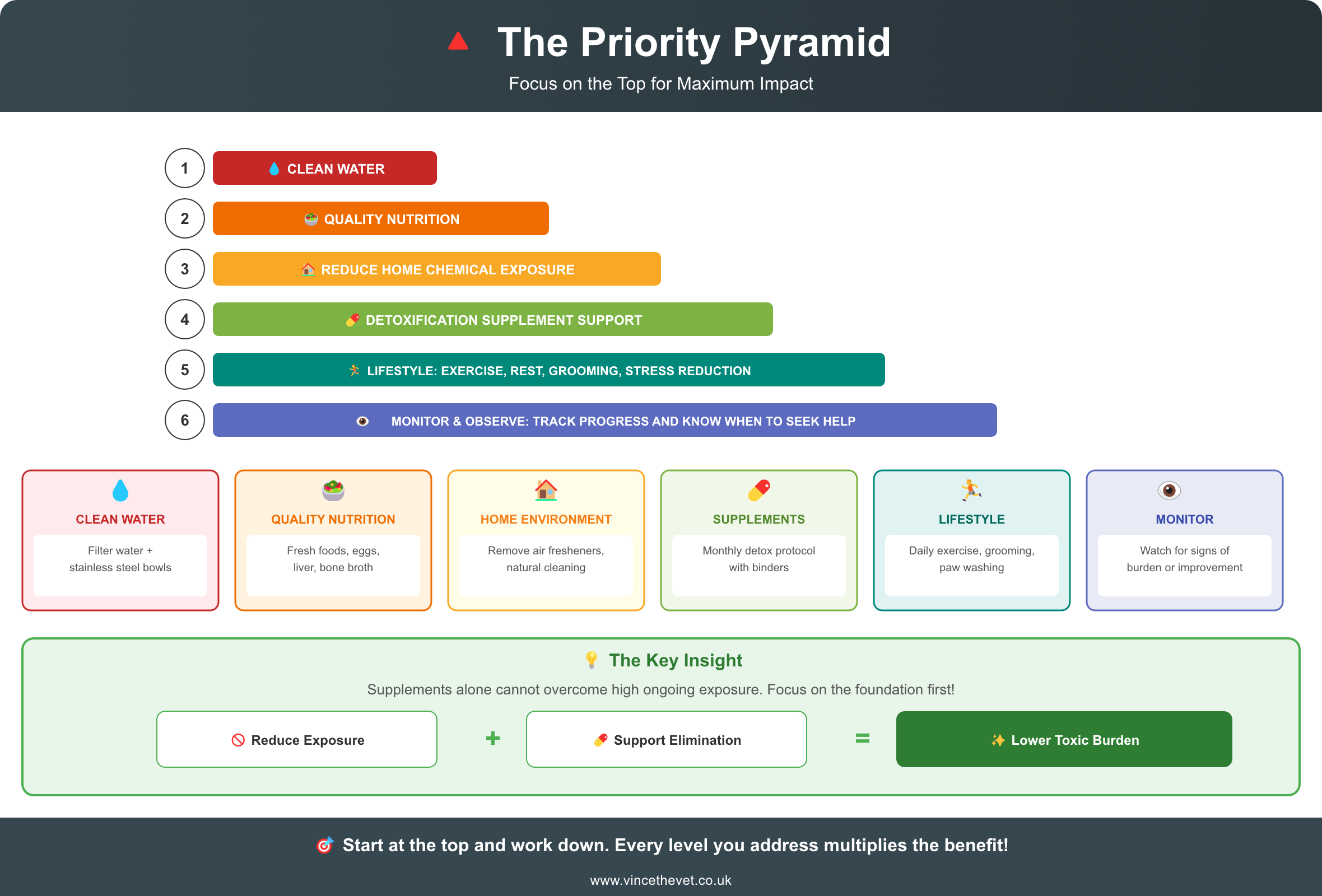
An Action Plan for Maximum Impact:
Practical measures listed in order of importance for protecting your pet from environmental pollution
Understanding the Challenge
We live in an unprecedented era of chemical pollution. Over 350,000 chemicals are registered for commercial use globally, yet fewer than 5% have been tested for safety. Our pets are exposed to these chemicals daily — through the air they breathe, the water they drink, the food they eat, and the surfaces they touch.
Research consistently shows that pets carry higher concentrations of many environmental toxins than their human families. This is due to their proximity to floors and treated surfaces, their grooming habits (ingesting chemicals from their coat), their faster metabolic rate, and their smaller body size.
While we cannot eliminate all exposure, we can take strategic action to minimise incoming toxins and support the body's ability to eliminate those that do enter. This guide presents a comprehensive, prioritised approach to protecting your pet's health.
THE CORE PRINCIPLE Prevention is always more effective than elimination. No supplement can fully compensate for high ongoing exposure. The most impactful steps are those that reduce the amount of toxins entering your pet's body in the first place. |
The Six Priorities — At a Glance
These measures are listed in order of impact. Focus on Priority 1 first, then work down the list as you're able.
Priority | Focus Area | Why It Matters |
1 | Clean Water | Water is consumed daily in large volumes; contaminated water is a constant source of toxins |
2 | Quality Nutrition | Food provides the boy's building blocks, and nutrients essential for detoxification pathways |
3 | Reduce Home Exposure | Pets spend most time indoors; home environment is within your control |
4 | Support Detoxification | Supplements help bind and eliminate toxins that do enter the body |
5 | Lifestyle Factors | Exercise, grooming, rest and stress reduction all support natural detoxification |
6 | Monitor Progress | Observing your pet helps you assess what's working and when to seek help |
PRIORITY 1: CLEAN WATER |
Why this is this top of the list?
While this might seem to be stating the obvious, water is consumed in large quantities every day. If the water source is contaminated, your pet is receiving a constant, unavoidable dose of toxins.
Cleaning up the water supply has an immediate and significant impact.
What's in Tap Water?
- Chlorine and chloramine — Added for disinfection; can disrupt gut microbiome
- Fluoride — Added in some areas; accumulates in bones over time
- Heavy metals — Lead (from old pipes), copper, arsenic
- Microplastics — Now found in virtually all tap water
- Pharmaceutical residues — Hormones, antibiotics, pain medications etc
- Agricultural chemicals — Pesticides, herbicides, nitrates
Action Steps
1. Filter your pet's drinking water — Use a quality water filter. Carbon filters remove chlorine and many organic compounds. Reverse osmosis removes heavy metals, fluoride, and most contaminants. Even a simple jug filter is better than nothing.
2. Use stainless steel or ceramic water bowls — Plastic bowls leach chemicals, especially when scratched or exposed to sunlight - discard.
3. Clean bowls daily — Biofilm (the slimy layer) accumulates bacteria and can trap toxins. Wash with hot water and a small amount of white vinegar (and natural soap if necessary, such a castile).
4. Provide fresh water frequently — Stagnant water accumulates more contaminants. Change water at least twice daily.
5. Avoid outdoor puddles and standing water — These concentrate pesticides, herbicides, and pollutants.
PRIORITY 2: QUALITY NUTRITION |
Why this is Priority 2?
Food provides the raw materials the body needs to detoxify. Without adequate protein, sulphur-containing amino acids, vitamins, and minerals, the liver simply cannot process toxins effectively. Poor quality food also adds to the toxic burden through additives, contaminants, and degraded fats.
What the Body Needs for Detoxification
Nutrient | Role in Detoxification | Good Sources |
Sulphur amino acids (methionine, cysteine) | Building blocks for glutathione (master antioxidant); essential for Phase II liver conjugation | Eggs, meat, fish, poultry Vince the Vet Joints |
Glycine | Required for Phase II conjugation; binds to toxins for elimination | Bone broth, collagen, gelatin, meat Vince the Vet Joints |
B vitamins | Cofactors for liver enzymes; support methylation pathways | Liver, meat, eggs, brewer's yeast Vince the Vet Digestion |
Zinc and Selenium | Cofactors for antioxidant enzymes; selenium supports glutathione peroxidase | Meat, fish, eggs, shellfish |
Antioxidants (vitamins A, C, E) | Protect organs from oxidative damage during detoxification | Liver, eggs, colourful vegetables (organic), berries Vince the Vet Vitality and Immunity |
Fibre | Binds toxins in gut; feeds beneficial bacteria; promotes regular elimination | Vegetables (organic), pumpkin, psyllium Vince the Vet Digestion |
- Feed fresh, whole foods where possible — Raw or lightly cooked meat, eggs, and nutrient dense natural supplements. Even adding the latter to kibble helps. (Guidance on feeding a high quality, complete, balanced raw or home-cooked diet can be found by clicking on these 2 links.)
- Avoid ultra-processed pet foods — These often contain synthetic additives, preservatives, degraded fats, and low-quality ingredients that add to toxic burden.
- Add eggs regularly — Excellent source of sulphur amino acids, choline, and selenium. Most dogs and cats can have 1 egg per 10kg body weight several times weekly.
- Include bone broth or Joints - Rich in glycine; supports gut lining; hydrating. Can be added to food or given separately.
- Add Digestion or a small amount of non-sweet organic vegetables (broccoli, cauliflower) for fibre.
- Avoid plastic food bowls and storage — Use stainless steel or ceramic. Store food in glass or stainless steel containers.
PRIORITY 3: REDUCE HOME EXPOSURE |
Why this is Priority 3?
Your pet spends most of their time at home. This is the environment you have most control over. Reducing exposure here significantly decreases their daily toxic load.
Key Sources of Home Chemical Exposure
NOTE - also refer back to 'Exposures You Can Reduce or Eliminate in Part 1
- Household cleaning products — Residues on floors, surfaces pets lick
- Air fresheners, scented candles, plug-ins — Release volatile organic compounds (VOCs)
- Flame retardants — In furniture, carpets, electronics; shed into household dust
- Carpets and rugs — Trap chemicals, dust, pesticide residues; treated with stain-resistant chemicals
- Garden chemicals — Tracked in on paws; lawn treatments, weed killers
- Flea and tick treatments — Most contain neurotoxic pesticides
Action Steps
- Switch to natural cleaning products — White vinegar, bicarbonate of soda, and castile soap handle most cleaning tasks. Avoid anything with 'fragrance' or 'parfum' in ingredients.
- Eliminate air fresheners — Stop using plug-ins, sprays, and scented candles. Open windows for fresh air instead.
- Vacuum frequently with a HEPA filter — Household dust is a major reservoir of flame retardants, pesticides, and microplastics. Vacuum 2 - 3 times weekly.
- Damp dust surfaces — Dry dusting spreads particles into the air. Use a damp cloth.
- Wash pet bedding weekly — Bedding accumulates dust, chemicals, and shed skin cells. Use hot water and white vinegar (plus csstile soap if necessary).
- Wash limbs and paws (clean water only) after walks — Removes pesticides, herbicides, and road chemicals before they're licked off.
- Avoid lawn chemicals — Don't treat your lawn with pesticides or herbicides. Keep pets off treated public lawns.
- Choose natural flea prevention — Consider natural alternatives to chemical spot-on treatments and oral pesticides - use natural alternatives instead.
- Ventilate your home — Open windows daily to reduce indoor air pollutants, even in winter (before dawn and after sunset when pollen counts are high).
PRIORITY 4: SUPPORT DETOXIFICATION |
Why this is Priority 4?
Even with reduced exposure, some toxins will still enter your pet's body. Targeted supplements can help bind these toxins in the gut before absorption and support the organs that process and eliminate them.
The Two-Pronged Approach
Effective detoxification support works on two levels:
• GUT BINDERS — Trap toxins in the digestive tract before they can be absorbed, carrying them out in faeces
• ORGAN SUPPORT — Help the liver, kidneys, and immune system process toxins that have already entered the body
Recommended Supplement Protocol (also see the top of the page):
This protocol uses Vince the Vet supplements, which have been specifically formulated to support natural detoxification:
Daily Foundation
- Digestion (Chicory Inulin + Brewer's Yeast) — Feeds beneficial gut bacteria that naturally bind heavy metals; provides B-vitamins for liver function; beta-glucans bind mycotoxins
- Vitality (Spirulina + Chlorella) — Primary binder; strong evidence for binding mercury, lead, cadmium, arsenic; may bind microplastics; powerful antioxidant protection
Monthly Intensive (first 7 days if each month)
• Detoxification Support (10-herb formula including Milk Thistle, Nettle, Pumpkin) — Liver protection and regeneration; kidney support; promotes healthy elimination
Optional Additions for Higher Exposure
- Chitosan — Strongest evidence for microplastic binding
- Zeolite (Clinoptilolite) — Excellent heavy metal binding via ion exchange
- N-Acetyl Cysteine (NAC) — Boosts glutathione; especially useful for older pets
- Probiotics — Support healthy gut bacteria that bind heavy metals (Time Health Bio cultures)
PRIORITY 5: LIFESTYLE FACTORS |
Why this is Priority 5?
Daily habits significantly influence the body's ability to detoxify. Exercise, rest, grooming, and stress management all play a role in supporting natural elimination pathways.
Exercise
Regular physical activity:
- Increases circulation, delivering nutrients to detox organs and carrying waste away
- Stimulates lymphatic drainage (the lymphatic system relies on movement)
- Supports healthy bowel movements
- Reduces stress hormones that impair detoxification
Aim for: Daily exercise appropriate to your pet's age and fitness level. For dogs, this means at least 30-60 minutes of walking plus play. For cats, interactive play sessions.
Rest and Sleep
The liver's detoxification activity peaks during sleep.
Pets need:
- Dogs: 12-14 hours of sleep daily (puppies and seniors need more)
- Cats: 12-16 hours of sleep daily
- A quiet, comfortable sleeping area away from disturbances
Grooming and Bathing
Regular grooming supports skin elimination:
- Brushing — Removes dust, chemicals, and dead skin; stimulates skin circulation
- Bathing — Washes away chemicals deposited on coat (use natural, fragrance-free shampoo; don't over-bathe)
- Limb and Paw washing / wiping — After walks, wipe paws to remove chemicals before grooming brings them into the body
Stress Reduction
Chronic stress impairs detoxification:
- Cortisol depletes glutathione (the master antioxidant)
- Stress hormones redirect blood flow away from digestive and detox organs
- Chronic anxiety impairs immune function
Support your pet's mental health through: Predictable routines, adequate exercise, mental stimulation, safe spaces to retreat to, and addressing any anxiety issues.
Regular Bowel Movements
Constipation allows toxins to be reabsorbed from the gut.
Ensure your pet has:
- Adequate fibre in the diet
- Plenty of fresh water
- Regular exercise
- Stress-free opportunity to eliminate (dogs: regular toilet breaks; cats: clean, accessible litter boxes)
Getting Started
Don't feel overwhelmed.
Begin with small changes and build from there.
For example:
Week 1:
- Replace plastic food and water bowls with stainless steel or ceramic
- Start filtering your pet's drinking water
- Remove plug-in air fresheners and scented candles
- Switch your floor cleaner to vinegar and water
- Begin your first 7- day intensive with Detoxification Support
Week 2:
- Start washing / wiping limbs and paws after every outdoor walk
- Increase vacuuming frequency (ideally with HEPA filter)
- Add Digestion to the diet (half a teaspoon per 10kg bodyweight daily, divided between meals for the first week, increasing to 1 teaspoon per 10kg bodyweight going forward, if the stools remain well-formed)
- Gradually improve diet quality
Week 3:
- Start washing / wiping limbs and paws after every outdoor walk
- Increase vacuuming frequency (ideally with HEPA filter)
- Switch to vinegar, bicarbonate of soda and castile soap if needed, for washing pet bedding, blankets, and anything your pet contacts regularly
Week 4:
- Add Vitality to the diet (half a teaspoon per 10kg bodyweight daily, divided between meals for the first week, increasing to 1 teaspoon per 10kg bodyweight going forward, if the stools remain well-formed)
Going forward
- Continue to implement the changes outlined in Part 2: Exposures You Can Reduce or Eliminate.
- Repeat the 7 - day intensive with Detoxification Support each month (the first week is easiest to remember).
- Add Immunity to your pets regime to bolster the body's immune defences during high-stress periods (when given strategically) or even better, give daily throughout the year.
- Work through the steps that apply to your pet in The Priority Pyramid, one by one.
NOTE:
Detoxification Support in addition to aiding the elimination of toxins, waste products and environmental chemicals from the body, also helps the body to eliminate parasites before they gain a foothold and cause infection.
REMEMBER Every small change makes a difference. You don't need to do everything at once. Focus on the highest priorities first, and build from there. Your pet's body has remarkable healing capacity when given the right support. |
This guide is for informational purposes only and does not replace veterinary advice.